
(the only pics I have of me are outside, lol)
I’m Alex, just an ambitious dude doing his part to create change in this world using his unique combination of skills and attitude. When I take in all of the different projects and ventures going on around me, I can’t help but feel that there are pieces missing. Though many of my peers are doing great things, I still feel like most don't think big enough. I believe the future of humanity is one of monumental building & invention at an epic scale beyond anything we have done in our history (think sci-fi). Because I have great tolerance for mission-driven risk and pain, I feel that it’s my responsibility to be the change I want to see in the world. In other words: I am driven to help push and maximize societal progress and prosperity, and an obvious path to accomplish this mission is to decrease costs of living and building across the board.
Ok Alex, that’s well and good, but what does “societal progress” and “prosperity” really mean? Well, tangibly, I look at it through two lenses:
1. Prosperity of opportunity and freedom at the individual level:
To allow people to chase meaning and find joy in their lives in the present, the lowest hanging fruit is to improve the resources people have, and give them more freedom to move themselves and their belongings around (physically) as they please. Practically, this is tied to things like transportation cost, energy cost, cost of living, cost of consumer products, etc. . Lowering economic barriers allows more freedom of choice with the money (resources) people do have.
2. Prosperity of the future of humanity:
Though this is inherently tied to the prosperity of individuals, it’s important to consider what “prosperity and progress” means in the context of humanity as a whole. For example, if we want humanity to eventually explore the galaxy, we will need to build technologies and mega-scale structures wildly beyond our current capabilities. To get to this kind of scale, cost of materials, processes, and energy have to drop by orders of magnitude - Thus is non-optional from a physics standpoint. This won’t happen if we continue to nickel and dime each other as a core business principle: We have to find ways to economically drive down costs, and faster, if we want to expand and prosper. In this I find great meaning, because cost-downs in industry will also drive down costs for ordinary people who use these same materials and processes as a second order effect. For a great example, see all the different kinds of technologies that trickled down to us from industrial and space applications (memory foam, phone cameras, GPS, etc.).
Because I know future progress is heavily dependent on economics of energy, resources, manufacturing, and logistics (transportation), I tend to think a lot about these things. These are things which, if constrained, provide significant friction on the path to building bigger and better things.
Energy: Energy is a fundamental input to most processes. This is unavoidable from a physics standpoint - To move things around or oppose entropy by arranging atoms in an ordered fashion, we must do work on the atoms, which requires energy.
Resources: Raw resources (materials) are also a physics-based input for creating and building "stuff". Even if the "stuff" in question is bits, materials are still required to hold and move them around.
Manufacturing: Manufacturing is the process of taking resources and applying some kind of work (energy) to them to transform the input into some kind of tangible output like a consumer product. This could mean doing some kind of process, or even just assembling two parts together. In any case, improving manufacturing capabilities and costs is really important to me because a many of our futuristic ideas and aspirations are just constrained by manufacturing complexity, speed, cost, or a combination of these. For an example of what happens when you break these constraints, think the 3D printing revolution.
Logistics: Since we live in a physical / geographical world, we have to be able to move energy, resources, products, and people around effectively. Since the important fundamental costs in the societal big picture are time and money, decreasing time and money required to move stuff around is a concrete way to move the needle in the long run. A noteworthy second order effect of this is that reducing costs associated to moving stuff around would lower barriers for humans moving around, which would in effect create more freedom and potentially amplify human network effects.
Though I don't limit myself to these subjects, I find that a lot of issues and "Why nots" I think about are constrained by some combination of these four factors.
Aside from my involvement in engineering and aspirations to work on meaningful large-scale projects, I also think that it's very important to be naturally curious of the world and intentionally experience as much of it as possible. While I do enjoy the city, there is profound truth to be found out in nature. Nature doesn't care about human scales, opinions, or preconceptions. Its order is based on the laws of physics.
Because of this, I really feel the most present when I'm outside taking in and navigating through my surroundings. Particularly, I’m into hiking, cycling, trail running, and skiing of various sorts because of how the focus demanded in these contexts grounds me to the present. I find that the constant but managed balance between pain and excitement presented by endurance sports is somewhat meditative and helps me process my thoughts subconsciously better.
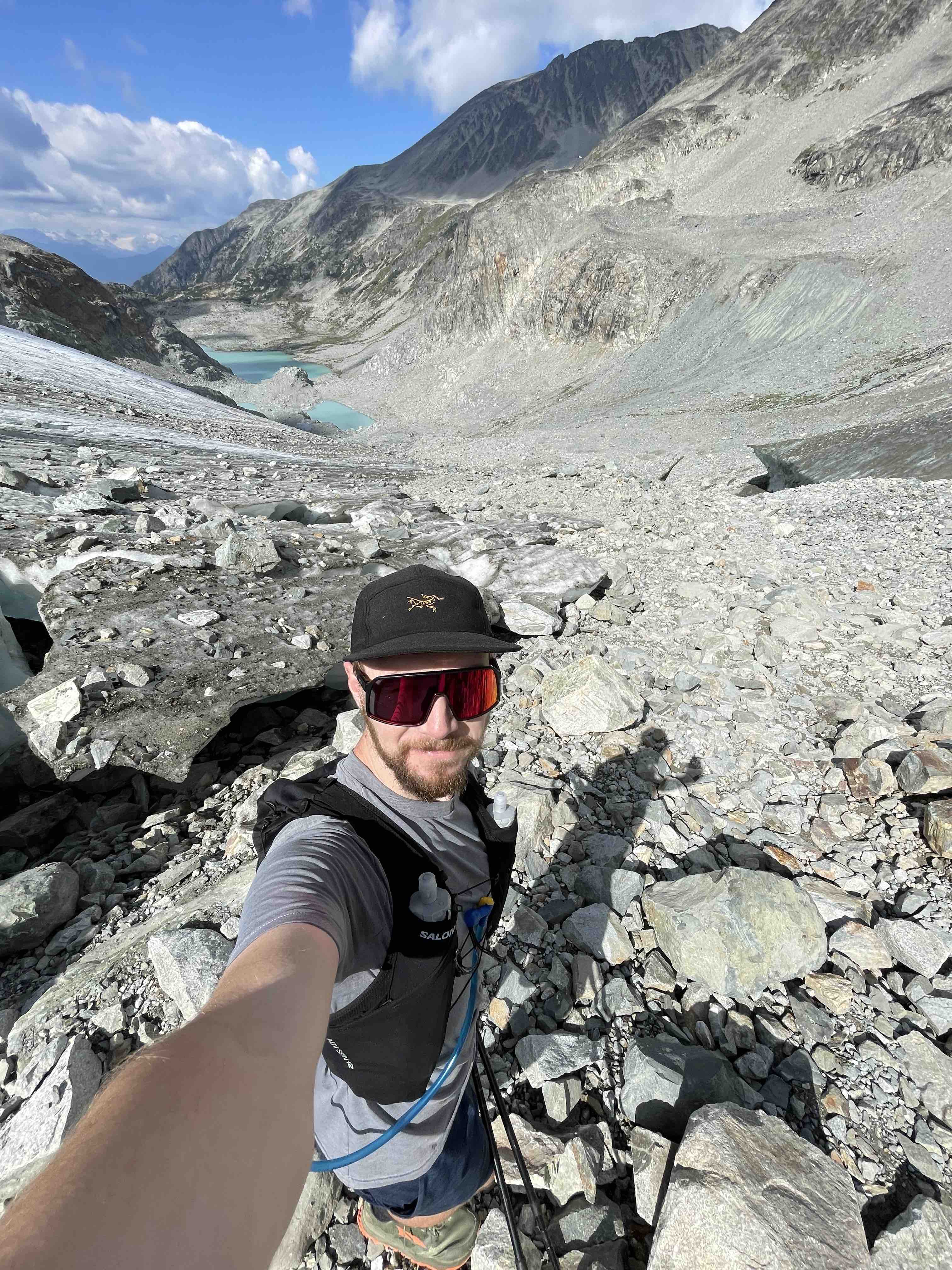
Toe of the Glacier above Wedgemount Lake
Music